With around 9,000 law firms in England and Wales alone, SEO for lawyers is not just about keywords or backlinks. It’s about establishing your legal firm as the go-to authority in your areas of practice. And this is more important than ever now there’s a new layer: AI search.
Search engines and AI models are now “answer engines”. With a single prompt, users now receive legal explanations and comparisons — sometimes without ever visiting a website.
The good news is the traffic generated is more high-intent and valuable than ever. So, the shift towards AI SEO for law firms doesn’t make traditional SEO less important. It makes clarity, authority, and conversion performance matter more.
In this guide, I’ll cover everything your law firm needs to know about AI SEO, local SEO, technical SEO and on-page SEO.
Does SEO for solicitors still work in 2026?
The question of whether SEO for lawyers remains a viable strategy in 2026 is one that I hear often. And it’s one that many law firms grapple with as we have entered into the AI area.
Let me clear things up.
Search is still a primary way people discover legal services. But the experience of search is changing.
The old playbook was simple: Rankings → Traffic → Conversions. But that’s changed.
My legal clients are increasingly closing more business from prospects engaging on AI platforms like ChatGPT and Google Gemini. Not by typing keywords, but by asking questions. And the biggest change is that users don’t always click through to websites when an AI summary appears.
Industry analysis shows that when AI Overviews appear for a query, click-through rates to traditional organic links can drop by 34–65%. And some estimates suggest that organic traffic is predicted to drop another 25% by the end of 2026.
So does SEO still work? Yes — but it’s evolving
Google still processes over 16 billion daily queries and roughly 9.5 million searches occur every minute.
This statistic not only underlines the sustained relevance of search engines as the primary gateway to the internet but also reinforces the critical role that SEO plays in generating both prospects and new customers for law firms.
Nevertheless, SEO for solicitors is becoming less about “chasing clicks” and more about:
- Building visible authority in traditional results
- Creating content AI systems can safely reuse
- Ensuring the website converts when higher-intent users do arrive.
This is where traditional SEO and AI search optimisation begin to overlap and reinforce each other.
What is law firm SEO?
Most people search online before they ever call a solicitor. SEO is how your firm gets found at that moment, and how you stay visible as AI platforms like ChatGPT and Google AI Overviews increasingly shape where clients turn first.
For legal services, where Google classifies content as Your Money or Your Life (YMYL), the bar for trust and accuracy is higher than almost any other industry.
Key points about SEO for solicitors:
- AI visibility: Get cited and recommended by AI models including ChatGPT, Perplexity, and Google AI Overviews when users ask legal questions in your practice areas.
- Search visibility: Appear on Google when potential clients search for the legal services you offer, from broad terms like “what is a settlement agreement” to high-intent queries like “best employment lawyers London.”
- E-E-A-T signals: Google assesses your firm’s Experience, Expertise, Authoritativeness, and Trustworthiness on every page. Named solicitors, verified credentials, SRA registration, and real client reviews all directly influence how your content ranks.
- Technical foundations: A fast and well-structured website gives search engines and AI systems the confidence to surface your content over competitors.
- Link building: Earn backlinks from credible publications and industry bodies to strengthen your domain authority and reinforce your law firm’s standing as a reliable entity.
AI SEO for lawyers: Why it changes discovery
Increasingly, potential clients are getting answers from AI systems that generate responses rather than list 10 blue links. These AI models:
- Read content across the web
- Extract explanations, definitions, and processes
- Summarise what they believe is most helpful
- Present a single answer, overview, or shortlist.
For law firms that ignore this shift, the risk isn’t just a dip in traffic. It’s quiet invisibility at the moment potential clients are forming trust, understanding options, and deciding who to contact.
The 3 layers of AI SEO visibility: AEO, GEO & LLMO
AI search isn’t a single system. It operates across three interconnected layers, aligned to how clients understand a problem and decide what to do next:
- AEO: being the answer
- GEO: becoming the source
- LLMO: earning recommendations.
Firms that perform well in AI search optimise for all three stages, supporting the entire decision pathway from first question to confident instruction.
What is AEO (answer engine optimisation)?
Answer engine optimisation helps AI systems confidently reuse your content when someone asks a specific, problem-led question. At this stage, the person isn’t choosing a law firm. They’re trying to understand whether they have a legal issue at all.
AI systems prioritise sources that provide:
- Clear explanations of what the issue is
- Simple definitions in plain English
- Accurate language they can repeat without risk
- Structure that makes the answer easy to extract.
Even if your legal firm isn’t named in the answer, your expertise can shape what the market understands.
What is GEO (generative engine optimisation)?
Generative engine optimisation comes into play once the basic question has been answered and the person wants a deeper dive.
At this stage, AI systems look for:
- What happens first
- What usually follows
- How long things take
- Where risks or delays arise.
Law firms that publish clear, experience-led explanations become reference points AI systems return to when generating longer summaries.
What is LLMO (large language model optimisation)?
LLMO is the recommendation layer, and it’s never built in isolation. AI systems only recommend firms they already “understand”.
That understanding is formed over time through repeated exposure to:
- Clear explanations (AEO)
- Structured insight (GEO)
- Consistent terminology
- Named expertise
- Third-party validation (e.g. mentions in trusted directories, the media etc).
Traditional SEO vs AI SEO: Do law firms need both?
Yes, law firms need both traditional search and AI search. And treating them as separate strategies is a mistake.
Because traditional SEO still:
- Drives direct traffic
- Supports high-intent searches
- Provides structure and authority signals.
And those same foundations underpin how both search engines and AI systems evaluate, interpret, and surface legal expertise in the first place.
How do search engines work for solicitor SEO?
At their core, search engines aim to provide users with the most relevant, authoritative, and trustworthy information based on their search queries.
For law firms, this aligns directly with E-E-A-T principles:
- Experience
- Expertise
- Authoritativeness
- Trustworthiness.
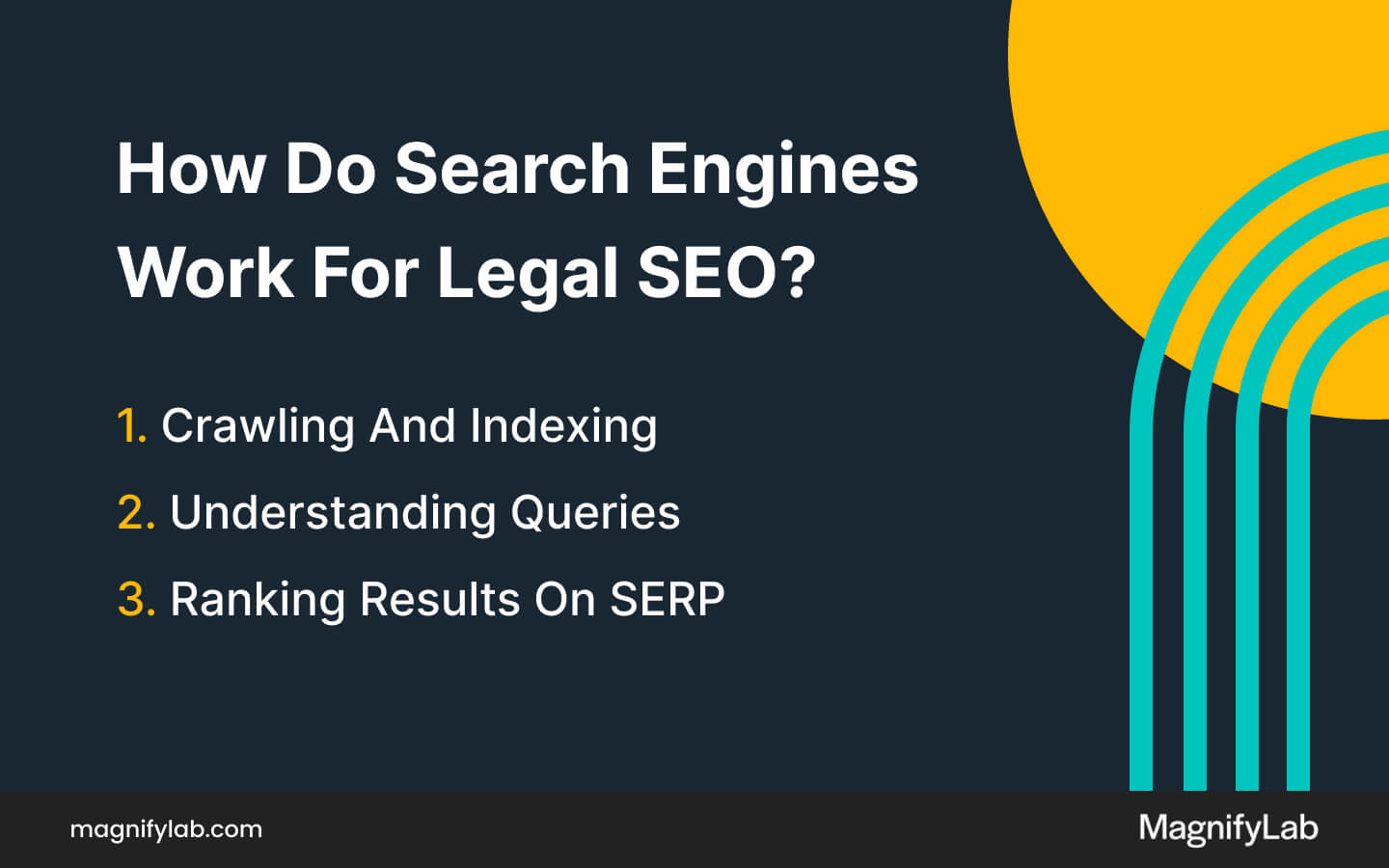
Search engines operate in three stages:
- Crawling and Indexing: Search engines use bots to crawl billions of web pages by following links from known pages to new ones, gathering data which they then index, or store, in a vast database.
- Understanding Queries: Once a user inputs a query, search engines strive to understand the intent behind it, whether it’s seeking information, looking to hire a lawyer, or researching a specific legal issue.
- Ranking Results: Based on the indexed information, search engines rank pages by relevance to the user’s query, taking into account factors like page content quality, user experience signals, and external links.
For solicitors, demonstrating credibility is non-negotiable. That means:
- Author bios with credentials.
- Transparent regulatory information (e.g. SRA details).
- Clear practice area depth.
- Secure and fast legal websites.
Google is no longer just matching keywords. It’s evaluating credibility.
How does Google rank legal content?
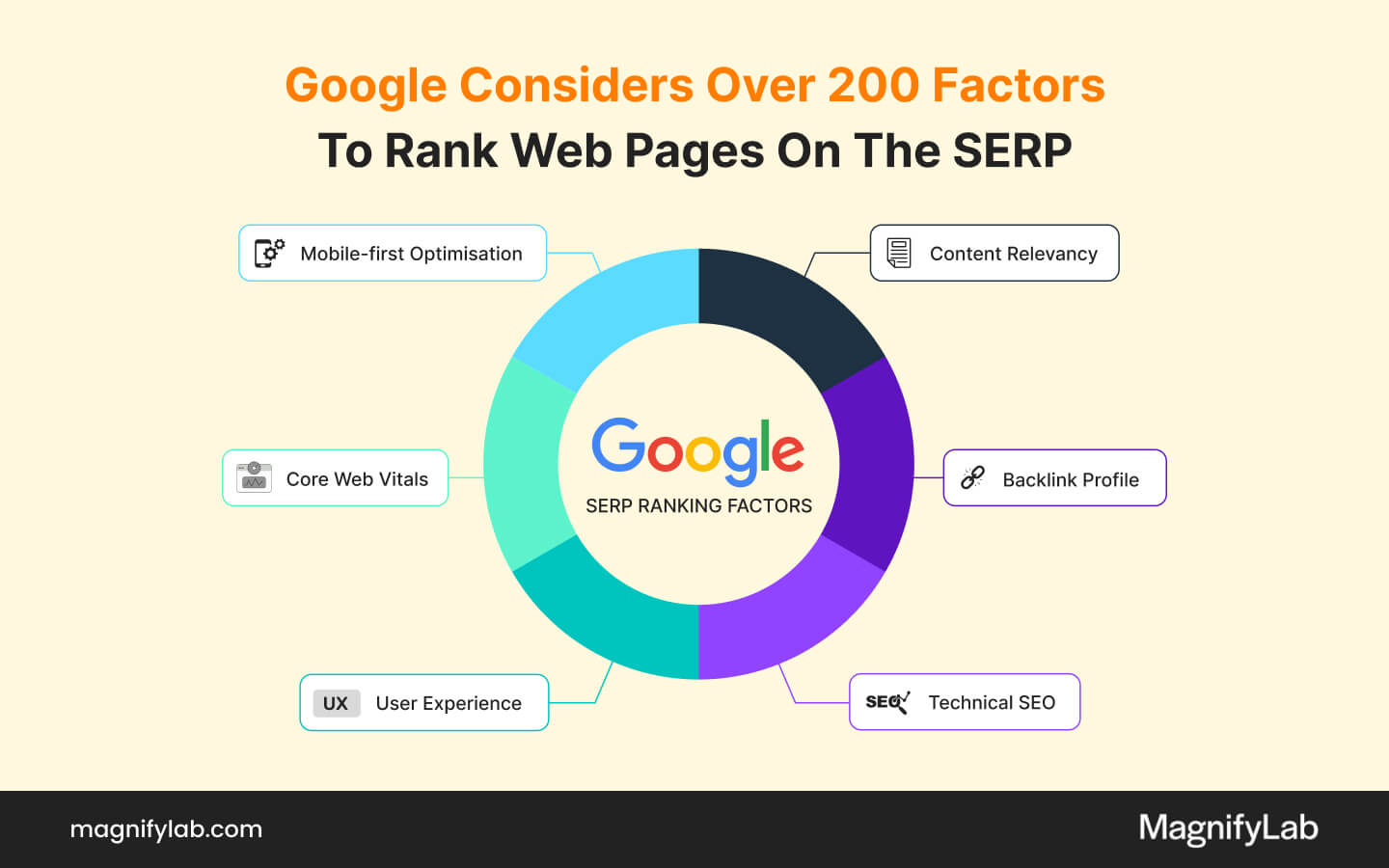
Google uses an AI-powered algorithm that draws on over 200 ranking signals to understand queries and decide which pages appear first. The goal is always the same: surface the most relevant, trustworthy, and useful content for each search query.
The most important signals include:
- Relevance: How well your content matches what the user is actually searching for, covering topics, intent, and context.
- Content quality: Original, well-researched content that genuinely answers the reader’s question. Thin or generic pages do not rank.
- Page experience: Mobile-friendliness, load speed, and safe browsing all contribute to how Google assesses usability.
- User engagement: Click-through rate, bounce rate, and time on page all signal whether your content is delivering real value.
- Backlinks: Links from credible websites act as endorsements, telling Google your content is worth referencing.
Mastering search intent: The 3 types of searches for law firms
Search intent describes the purpose behind a user’s query. Every search falls into one of three keyword categories: informational, navigational, or transactional.
In 2026, what has changed is not intent itself, but where it gets satisfied — AI systems now answer many legal questions before a user ever visits a website.
* Informational: Users at the research stage (e.g. “how much does a divorce cost?”).
* Navigational: Users who already know your firm and are trying to find you (e.g. “Slater and Gordon London”).
* Transactional: Users ready to instruct. Many will have already received a legal explanation from an AI system before landing on your law firm website (e.g. “personal injury solicitors London”)
How to build a law firm SEO strategy that actually works
Most law firm SEO strategies fail not because the tactics are wrong, but because there is no strategy behind them.
Before publishing content or building links, you need a clear picture of where your firm currently stands and what success looks like in measurable terms.
Local SEO for law firms
Whether your firm operates from one office or several, local SEO directly determines whether potential clients find you or a competitor.
Appearing here puts your law firm in front of high-intent users at the exact moment they are ready to act.
For further insights, read our recently published local SEO for law firm guide.
The three pillars of map pack rankings
Google uses three signals to decide which firms appear:
- Relevance: How closely your Google Business Profile matches the search query. A complete, detailed profile increases your chances significantly.
- Distance: How close your law firm is to the user’s location or the location specified in the search.
- Prominence: How well-known and trusted your law firm is online, measured through reviews, ratings, backlinks, and consistent business information across the web.
How to appear in the Google map pack
- Google Business Profile: Keep it complete and current. Accurate name, address, phone number, opening hours, service categories, and regular photo updates all contribute to stronger visibility.
- NAP consistency: Your firm’s name, address, and phone number must be identical across every directory listing including Yelp, Bing Places, Yell, and legal directories. Inconsistency weakens both Map Pack rankings and AI visibility.
- Reviews: Actively request reviews from clients and respond to every one. Volume, recency, and rating all influence prominence directly.
- Local keywords: Include location-specific terms naturally across your service pages, meta tags, and content to reinforce where your firm operates and who it serves.
Why this still matters in an AI-led search landscape
Local intent remains one of the strongest commercial signals in search. AI systems including Google AI Overviews increasingly draw on Google Business Profiles, reviews, and directory data when generating local recommendations.
Getting found is no longer just about ranking in the Map Pack. It is about ensuring your legal firm’s identity, location, and credibility are consistently understood across every platform your potential clients use.
On-page SEO strategies for law firms
In 2026, a potential client’s first interaction with your law firm may not be a click. It could be an AI summary, a comparison panel, or a snippet pulled directly from your content.
On-page SEO is no longer just about ranking. It is about making your content easy to understand, easy to extract, and easy to trust across both traditional search and AI systems.
Understanding on-page SEO for solicitors
On-page SEO refers to optimising individual web pages so they perform well in search results and provide a strong user experience.
It includes:
- Page content
- HTML elements
- Page structure
- Internal linking
- Schema markup
Unlike off-page SEO, on-page optimisation is fully within your control. And increasingly, it shapes how your legal firm is understood — not just how it ranks.
5 key on-page SEO strategies for lawyers
1. Title tags and meta descriptions
Your title tag and meta description are the first thing a potential client sees in search results. Include your practice area, location, and a clear service description.
For example, “Employment Law Solicitors in Manchester” outperforms “Our Services” for both click-through rates and AI entity recognition.
For blog posts, add power words or numbers to your titles. “5 Things to Do After a Road Traffic Accident” consistently outperforms generic alternatives on CTR.
2. High quality content
Cover each practice area across the full funnel. Informational blog posts capture early-stage researchers. Detailed service pages convert high-intent visitors who are ready to instruct. Both matter, and both need to work together.
Content that performs best in 2026 follows a clear structure:
- Question-led heading
- Direct answer in the opening paragraph
- Structured explanation
- “What happens next” section
This format supports traditional rankings and AI extractability simultaneously.
For a deeper look at building a content strategy, our content marketing for law firms guide covers exactly that.
3. Keyword placements
Keywords should appear naturally in your H1, opening paragraph, at least one H2, and throughout the body without forced repetition. Search engines and AI systems read your heading structure to understand page hierarchy and topic relevance.
Use a clean H1 to H2 to H3 structure on every page. Avoid skipping heading levels or using multiple H1 tags. Clear structure helps both users and machines understand your content at a glance.
4. Internal linking
Internal linking builds topical authority and helps users, search engines, and AI systems understand how your content connects. Link between related practice areas, use descriptive anchor text, and maintain a clear parent and child page structure.
Avoid orphan pages. Every page on your site should be reachable through at least one internal link, and every piece of content should point users toward a logical next step.
5. Dwell time and engagement
Dwell time, the amount of time a user spends on your page before returning to search results, signals whether your content is genuinely useful. Following the Google document leak, it has been identified as a potentially significant ranking factor.
Keep users engaged with well-structured content, clear section headers, and a natural reading flow that guides them from the question they arrived with to the action you want them to take.
Off-page SEO strategies for law firms
Off-page SEO strategies extend your reach beyond your site, building the authority and trustworthiness that search engines & AI models rely on.
Next, we explore effective off-page SEO techniques for law firms, focusing on backlinks and strategic authority-building methods designed to strengthen your law firm’s digital reputation.
What’s a backlink?
A backlink is a hyperlink from one website pointing to another. In SEO, backlinks function as third-party endorsements of your content’s credibility and relevance.
For law firms, acquiring backlinks from authoritative sources is akin to receiving professional recommendations. They signal that your firm is recognised as a credible contributor within the legal domain. This endorsement can significantly impact your search engine rankings, driving more organic traffic to your website.
In an AI-influenced search environment, they also increasingly act as validation signals. Reinforcing that your firm is referenced, cited, and trusted beyond its own website.
Link quality factors
Not all backlinks are created equal. The quality of backlinks plays a critical role in determining their impact on your SEO efforts.
Popular types of backlinks include:
- Guest blogging: Write for reputable legal publications and industry blogs to build authority and earn contextual links back to your site.
- Content promotion: Publish original research, case studies, or legal guides that other sites naturally want to reference and link to.
- Local directories: List your firm on Google Business Profile, Bing Places, and legal directories. These links support local SEO and reinforce your firm’s entity signals.
- Partnerships and collaborations: Work with legal associations, complementary firms, or industry bodies on events or content. Credible partnerships generate credible links.
- Press and media coverage: Earn coverage through awards, commentary, or newsworthy achievements. Media backlinks carry strong authority and trust signals.
In an AI-led search environment, contextual expert citations carry particular weight. AI systems assess who is referenced, where, and in what context when building trust models around your firm.
Technical SEO marketing for solicitors
Strong technical foundations do not just support rankings. They determine whether your content can be reliably accessed, interpreted, and trusted by both search engines and AI systems.
What is technical SEO for law firms?
Technical SEO for law firms covers the infrastructure of your website: how it is structured, how fast it loads, and how easily search engines and AI systems can crawl and extract your content.
Weak technical foundations make your expertise harder to surface, regardless of how good your content is.
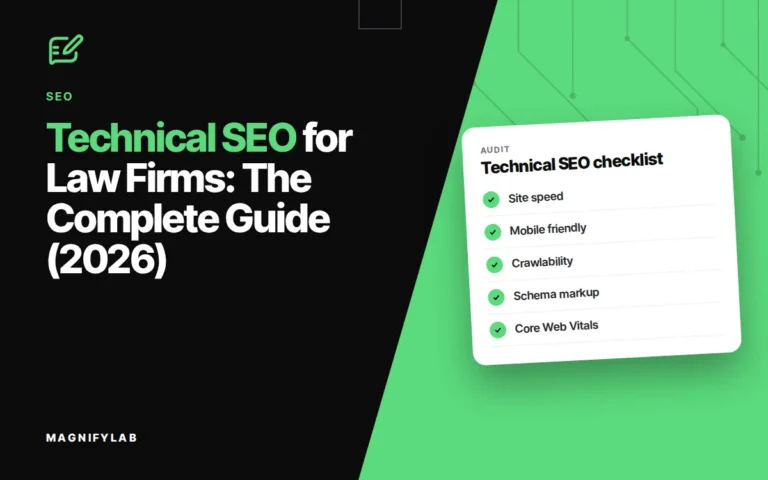
7 key technical SEO strategies
1. Website structure and navigation
A logical site structure helps users and search engines find information quickly. Each practice area should have its own dedicated page, with a clear hierarchy that moves from broad service categories down to specific sub-practice pages.
In 2026, clean architecture also reinforces topical authority with AI systems. A well-organised structure signals what your firm genuinely specialises in and reduces ambiguity about your expertise.
2. Page experience signals
Google’s Core Web Vitals measure three things: loading speed (LCP), interactivity (FID), and visual stability (CLS).
Target benchmarks are an LCP under 2.5 seconds, an FID under 100 milliseconds, and a CLS score below 0.1. Missing these thresholds directly affects both user experience and rankings.
3. Mobile-friendly website design
Google indexes the mobile version of your law firm website first. A responsive design that performs well on all screen sizes is not optional. It is a baseline requirement for visibility.
4. Website speed
Slow pages increase bounce rates and reduce conversions. Compress images, minimise code, leverage browser caching, and consider a content delivery network (CDN) to keep load times under control.
5. Schema markup
Schema markup tells search engines and AI systems what your content means. For law firms, LegalService, FAQ, Person, and AggregateRating schema all strengthen how your firm is understood and surfaced across both traditional search and AI-generated answers.
6. Crawl errors and broken links
Crawl errors and broken links prevent search engines from indexing your content and frustrate users. Audit your site regularly using Google Search Console and SEMrush. Fixing these issues keeps your site healthy, fully indexed, and performing at its best.
How long does SEO take for law firms?
SEO for law firms is a marathon and not a sprint. Most legal firms start seeing meaningful movement between months three and six, with compounding returns building steadily from there.
The timeline depends heavily on your starting point, the competitiveness of your practice areas, and how consistently the work is done.
| Timeframe | What to Expect |
| Month 1 to 2 | Technical audit and fixes, site structure improvements, Google Business Profile optimisation, and initial content published. Foundations being set. Little visible ranking movement at this stage. |
| Month 3 to 4 | Long-tail and local keywords begin to move. Practice area pages start indexing properly. Early increases in organic impressions and local search visibility. |
| Month 4 to 6 | Rankings strengthen across targeted practice areas. Organic traffic increases. First measurable uplift in enquiries from search. AI citation begins as content builds authority. |
| Month 6 to 12 | Topical authority compounds. Stronger, more competitive keywords start to move. Consistent enquiry flow from organic search. ROI becomes clearly measurable. |
| Month 12 and beyond | Sustained visibility across core practice areas. Content clusters drive ongoing traffic. Brand cited across AI platforms. SEO becomes a reliable and scalable source of instructions. |
London and other major cities take longer for high-volume keywords. Niche practice areas and mid-size cities often show faster movement. Firms that treat SEO as a continuous discipline rather than a campaign consistently outperform those that don’t.
How to optimise a law firm website for SEO
Effective law firm SEO starts with the right foundations. Platform, design, and content all feed into how your website ranks, how AI systems interpret it, and how confidently a potential client decides to get in touch.
Whether you’re focusing on personal injury SEO, family law SEO, or employment law SEO, organic search is absolutely fundamental to maximise your growth objectives.
1. Build your website in WordPress
WordPress remains our recommended CMS for law firms. Its flexibility, SEO-friendly architecture, and extensive plugin ecosystem make it the strongest platform for building a site that performs in both traditional search and AI-driven environments. The right setup from day one saves significant rework later.
2. Design for users, search engines & AI
A clean, well-structured design improves user experience and directly influences rankings. Three areas matter most:
- Mobile performance: Google indexes the mobile version of your site first. Responsive design is non-negotiable.
- Page speed: Compress images and leverage caching to keep load times under 2.5 seconds. Slow pages lose both users and rankings.
- Navigation: Clear, logical site structure helps users find what they need and helps search engines and AI models understand your services and areas of expertise.
For inspiration, take a look at our pick of the best law firm website designs.
3. Develop content that ranks and gets cited
Content built around real client questions, structured with clear headings, direct answers, and logical next steps, performs best across both Google and AI systems.
Avoid duplication. Every page should have a distinct purpose, a clear keyword focus, and original insights that reflect genuine legal expertise.
4. Build a brand that reinforces trust
Consistent branding across your website, directories, and social profiles strengthens entity recognition. Google and AI systems use brand consistency as a trust signal.
Your logo, messaging, and firm description should tell the same story everywhere they appear. Clear articulation of your practice areas, values, and differentiation also supports E-E-A-T signals across every page.
Final thoughts on SEO for solicitors
If there’s one thing I’ve learned working with law firms, it’s this: visibility doesn’t happen by accident.
The fundamentals still matter.What has changed is how people search. Prospective clients now encounter map listings, AI summaries, and comparison panels before they ever click through to a website. In many cases, they form an opinion about a firm before they visit it.
That doesn’t mean SEO is dead. It means it has matured.
The law firms that win long term are the ones that treat SEO as an ongoing discipline rather than a one-off project. Real authority builds slowly, then compounds.
If you’re wondering whether your law firm is genuinely visible, not just ranking but understood and trusted, it’s worth taking a proper look at the bigger picture.
For specialist assistance, contact our law firm SEO agency today for a free audit.