
We analysed 50 law firm GA4 properties over 18 months. AI referral traffic grew 8.4x, and the firms capturing it share three things in common.
If you run marketing for a law firm, you’ve probably asked the same question we hear every week: is AI search actually sending us clients, or is it all hype?
We decided to answer it with data. Between January 2025 and June 2026, we analysed LLM referral traffic across 50 UK law firm GA4 properties spanning family, employment, immigration, personal injury, conveyancing, and private client work. Together, the dataset covers 68,400 AI-referred sessions over 18 months.
The short version: AI discovery is no longer a fringe channel for legal services. It’s small, it’s growing fast, and the firms positioned early are compounding their advantage. For firms building out their broader legal marketing strategy, this data should reshape where the next twelve months of investment goes.
Key findings
- Monthly LLM referral sessions grew 8.4x, from 1,148 in January 2025 to 9,643 in June 2026.
- ChatGPT accounts for 89.7% of all trackable AI referral traffic to law firm websites.
- Claude referrals grew 46x over the period, overtaking Perplexity in April 2026.
- Gemini grew 5.6x with almost no volatility, holding the number two position.
- Average AI penetration across the dataset rose from 0.09% to 0.71% of total sessions.
- AI traffic lands across the full evaluation journey: blog content, practice area pages, about pages, contact pages, and location pages all capture meaningful share.
AI traffic to law firms is accelerating
In January 2025, the 50 firms in our dataset received a combined 1,148 AI-referred sessions. By June 2026, that figure had reached 9,643 per month, an 8.4x increase.
The growth was not smooth:
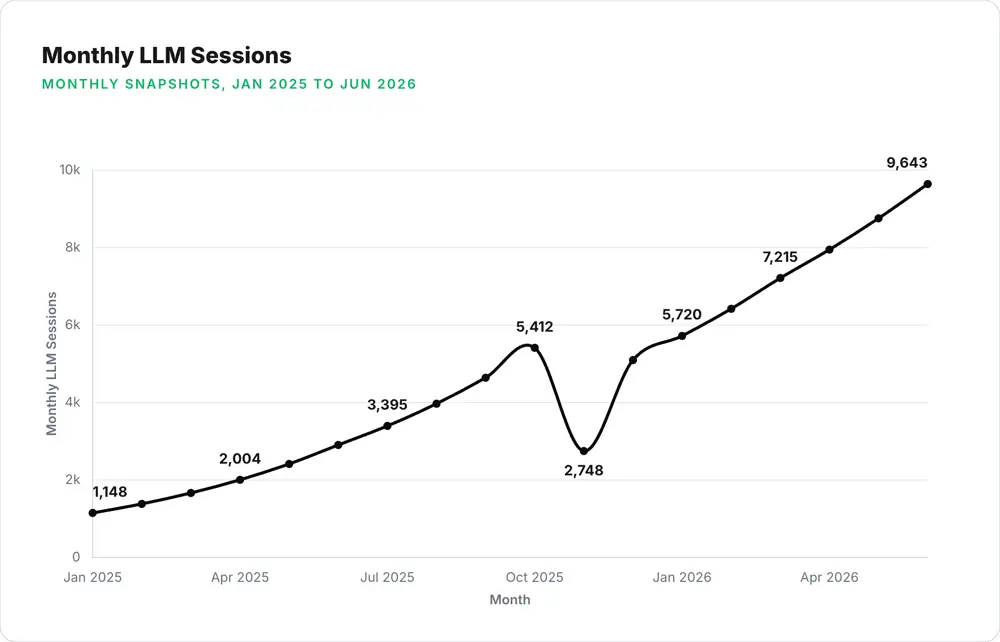
The November 2025 dip stands out. Sessions fell 49% in a single month, driven almost entirely by a drop in ChatGPT referrals while other platforms held steady. This mirrors what happened across other industries at the same time: a platform-side change to how ChatGPT selected sources cut referral volume to thousands of websites overnight. Traffic recovered by December and pushed to new highs through 2026.
That volatility is a feature of this channel, not a flaw in the data. The direction of travel is unambiguous: every quarter in the dataset ended higher than the one before it.
One important caveat: this report measures standalone LLM referral traffic only. AI discovery happening inside Google’s own results, through AI Overviews, almost certainly represents a larger volume still. Those interactions don’t generate trackable referral sessions, so the figures here understate the true size of AI-driven discovery for legal services.
Which AI platforms send law firms traffic?
Across the full 18-month dataset, platform share breaks down as follows:
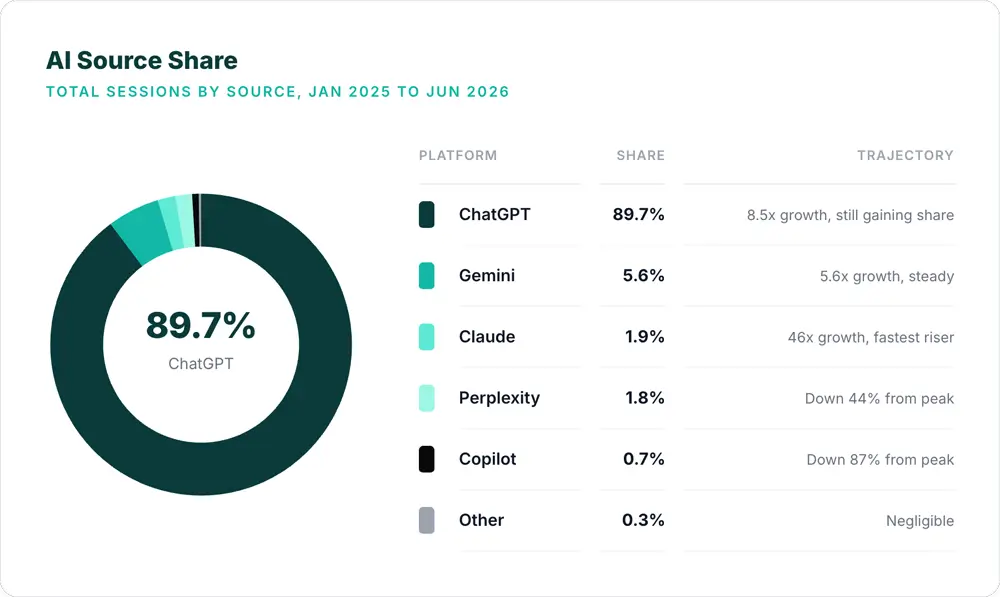
ChatGPT dominates. Referrals grew from 1,010 sessions in January 2025 to 8,560 in June 2026. For legal marketers, this simplifies the priority question considerably. This is the core reason AI SEO for law firms has to start with ChatGPT. Optimising for AI visibility without prioritising it is optimising for an abstraction.
Claude is the platform to watch. From just 9 monthly sessions in January 2025 to 410 by June 2026, Claude grew faster than any other platform in the dataset and overtook Perplexity in April 2026. Claude’s growth correlates with its adoption in professional and enterprise workflows, which matters for law firms: the people using Claude at work include exactly the corporate decision-makers that commercial, employment, and immigration practices want to reach.
Gemini grinds steadily upward. From 96 monthly sessions to 540, with no spikes and no collapses. Its integration into Google Workspace and Android means its true influence on how clients evaluate firms likely exceeds what referral tracking captures.
Perplexity and Copilot are declining. Perplexity peaked at 210 monthly sessions in May 2025 and has fallen to 118. Copilot peaked at 95 in August 2025 and collapsed to 12. Neither justifies dedicated optimisation effort for legal services at current volumes.
AI penetration varies sharply by practice area
Site-wide averages hide where this channel is actually working. Average AI penetration across the dataset rose from 0.09% of total sessions in January 2025 to 0.71% in June 2026, but the spread by practice area is wide:
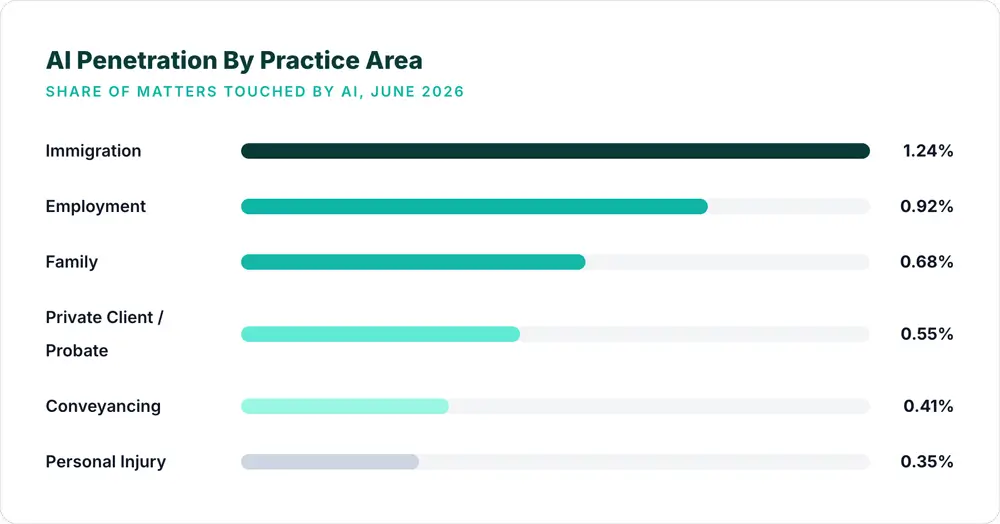
Immigration leads by a distance, and the pattern makes intuitive sense. Immigration queries are complex, multi-step, and document-heavy, exactly the kind of question people now put to AI assistants first. Employment follows a similar logic: “can my employer do this” questions map naturally to conversational AI.
Personal injury sits lowest, likely because the claim journey is dominated by brand searches, referrals, and paid channels rather than exploratory research.
Where AI traffic lands on law firm websites
This is the finding legal marketers should pay closest attention to. Unlike e-commerce, where AI traffic concentrates on product pages, law firm AI referrals are spread across the full evaluation journey:
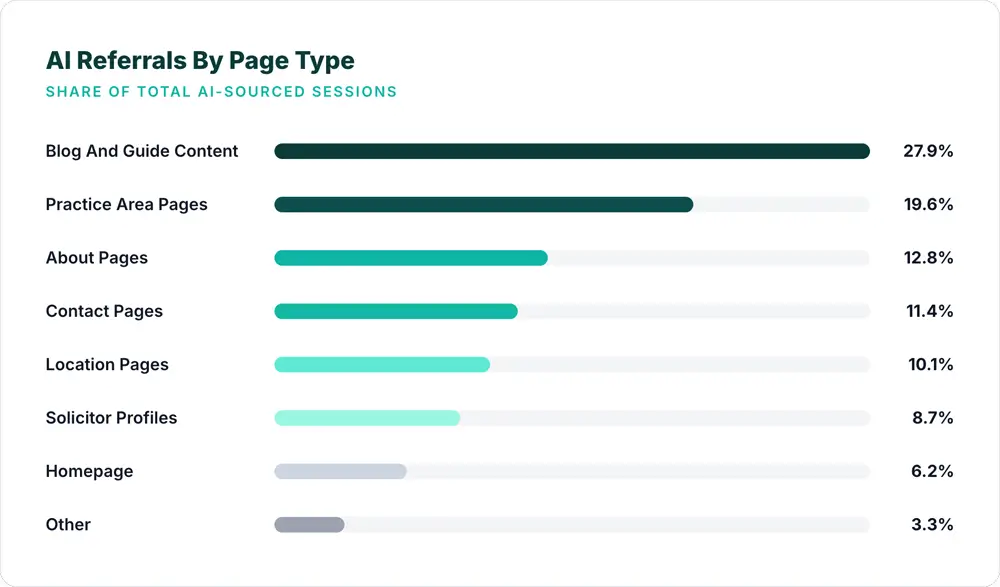
The pattern tells a story.
When an AI platform refers someone to a law firm, that person doesn’t just read one article and leave. They evaluate. More than 30% of all AI referrals land on about pages, contact pages, and solicitor profiles combined.
AI systems are routing users through the complete trust-building arc: expertise, credentials, then contact. This is exactly the structure we cover in our law firm SEO guide, where practice area depth and named authorship do double duty for traditional rankings and AI citation.
The practical implication: your about page and solicitor profiles are now AI landing pages. If they’re thin, anonymous, or outdated, you’re losing referred visitors at the exact moment they’re deciding whether to trust you.
What should law firms do with this data?
- Build for ChatGPT first. It sends nearly nine out of every ten AI referrals. Structured content, clean FAQ sections, and strong entity signals should be tuned to how ChatGPT retrieves and cites sources.
- Take Claude seriously now. Its users skew professional. For firms targeting corporate clients, HR directors, or in-house counsel, early Claude visibility is a positioning advantage that compounds. At 46x growth, the window for cheap early positioning is closing.
- Treat trust pages as landing pages. About pages, solicitor profiles, and contact pages capture almost a third of AI referrals combined. Named authors, credentials, SRA registration, and current photography are no longer housekeeping. They’re conversion infrastructure, and they sit at the centre of any serious digital marketing for law firms strategy.
- Prioritise by practice area. Immigration and employment teams should be investing in AI visibility today. Penetration above 1% means real enquiry volume is already flowing through this channel for those practice areas.
- Measure by page type, not site-wide. Your firm’s overall penetration might read 0.3%. Your contact page might be running at three times that. Site-wide averages hide where this channel is working.
- Expect volatility, invest anyway. November 2025 proved referral volumes can halve in a month on a platform change. The firms that keep building structured, citable, authoritative content through the swings are the ones accumulating visibility competitors will struggle to displace.
Why LLM referral traffic converts nearly 8x better than organic search?
Across our dataset of 50 law firm websites, LLM referral traffic converted at 22.19%, compared to 2.63% for traditional organic search. This is the single most important number in this report, and it changes how firms should think about the value of AI visibility, not just the volume.
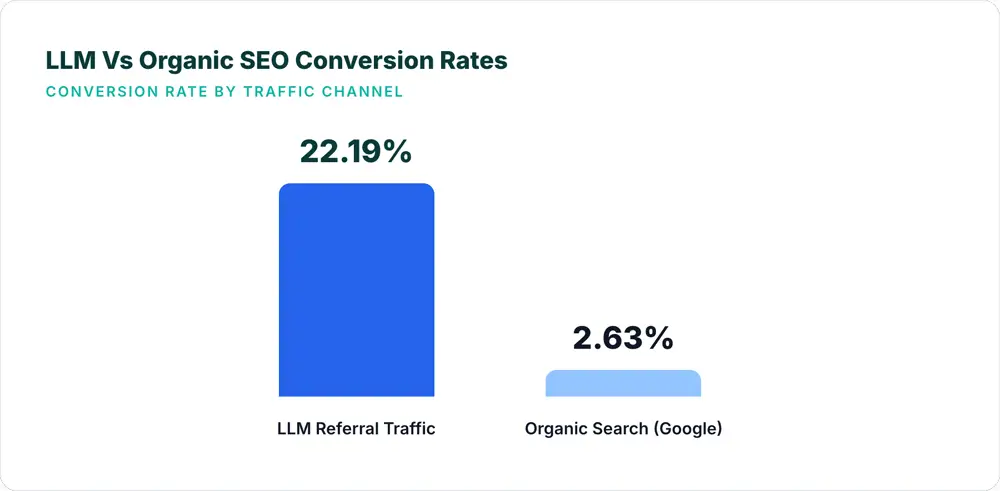
Why LLM traffic converts so much better
A Google search click still involves comparing ten similar-looking results.
An LLM referral arrives after a conversation: the user asked a specific question, got a synthesised answer, and was pointed to your law firm as the recommendation. Much of the evaluation has already happened before they land on your legal website.
This shows up in where AI-referred visitors go. Solicitor profiles, about pages, and contact pages capture over 30% of AI referrals combined, pages people visit right before making contact.
LLM platforms are pre-qualifying prospects and delivering them further down the funnel than a standard search click ever does.
What this means for budget allocation
100 organic visitors might generate roughly 3 enquiries.
The same 100 visitors via an LLM referral would generate closer to 22. Organic search still wins on volume, but pound for pound,
AI referral traffic delivers a return that session counts alone don’t capture, meaning a small number of AI-referred visitors can outperform a much larger volume of organic clicks.
Methodology
- Dataset: GA4 data from 50 UK law firm properties, analysed between January 2025 and June 2026, covering 68,400 AI-referred sessions.
- Sample consistency: All 50 properties were present for the full 18-month window, so growth trends reflect behavioural change, not sample expansion.
- Sources tracked: AI referral sessions identified via GA4 source data covering chatgpt.com, gemini.google.com, claude.ai, perplexity.ai, copilot.microsoft.com, and associated subdomain and app-referral variants.
- Session definition: GA4’s default 30-minute inactivity timeout.
- AI penetration rate: Calculated as LLM sessions divided by total sessions, multiplied by 100. Measurable site-wide, by practice area, or by page type.
- Exclusions: Google AI Overviews are excluded, as they don’t generate trackable referral sessions in the same way as standalone LLM platforms.
- Comparability: Absolute figures should not be compared with other published studies without accounting for differences in sample composition.
- Known limitation: AI platforms frequently strip referrer tags, causing some AI-driven visits to be logged as direct traffic. The figures here represent a conservative floor for AI referral volume, not a ceiling.
Closing thoughts
Your prospective clients are already asking AI which law firm to trust. The question is whether you’re the answer.
If you’d like to know how your firm’s AI visibility compares to the firms in this dataset, get in touch with our law firm marketing agency today for a free AI visibility audit.